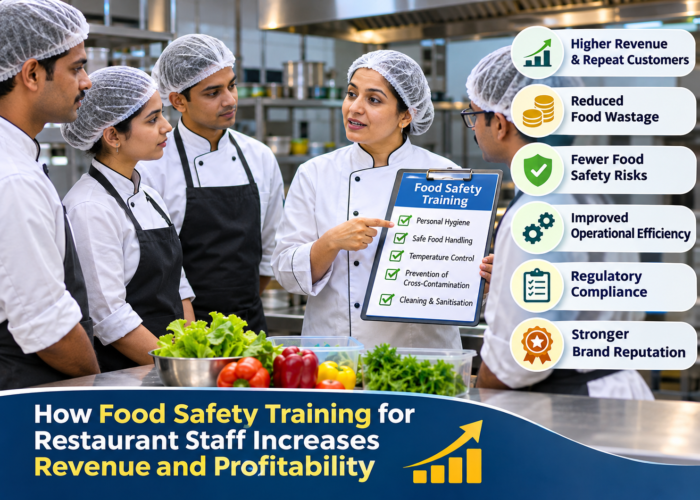
Running a successful restaurant is not just about serving delicious food, offering attractive prices or creating a pleasant dining experience. Behind every successful food business is an efficient kitchen team that understands the importance of food quality, hygiene and safety.
But have you ever considered that training your restaurant staff in food safety could actually increase your revenue and profitability?
Many restaurant owners consider food safety training an additional business expense or simply a regulatory requirement. However, effective food safety training is much more than compliance. It is an investment in customer satisfaction, operational efficiency, brand reputation and long-term business growth.
From reducing food wastage to encouraging repeat customers, trained employees can contribute significantly to a restaurant’s financial performance.
Let’s explore how food safety training can help restaurant owners improve their business profitability.
1. Customer Trust Leads to Repeat Business and Higher Revenue
Customers may initially visit a restaurant because of its menu, location, pricing or recommendations. However, their decision to return is influenced by their overall experience, including the cleanliness of the premises and confidence in food hygiene.
Imagine two restaurants offering similar menus and prices. One maintains visibly clean food preparation areas, hygienic serving practices and well-trained staff. The other has inconsistent hygiene practices.
Which restaurant would you trust with your next meal?
Customers are increasingly conscious of food hygiene and safety. Properly trained restaurant employees understand the importance of:
Washing hands correctly and at appropriate times.
Wearing clean uniforms and maintaining personal hygiene.
Preventing cross-contamination between raw and cooked foods.
Maintaining appropriate food storage temperatures.
Following safe food preparation and serving practices.
Keeping kitchen equipment and food contact surfaces clean.
How does this increase revenue?
When customers feel confident about a restaurant’s hygiene practices, they are more likely to return, recommend the establishment to friends and family, and develop long-term loyalty.
Repeat customers provide a valuable source of recurring business and help reduce dependence on expensive customer acquisition activities.
2. Reduced Food Wastage Means Higher Profit Margins
Food wastage is one of the biggest avoidable expenses in restaurant operations.
Ingredients may become unsafe or unusable because of improper storage, incorrect temperature control, poor stock rotation, contamination or mishandling.
Even small daily losses can accumulate into substantial monthly expenses.
Food safety training helps employees understand proper inventory management and safe food handling.
Important practices include:
FIFO (First In, First Out): Using older stock before newer stock, where appropriate.
FEFO (First Expired, First Out): Prioritising products with earlier expiry dates.
Maintaining appropriate refrigeration and freezing temperatures.
Storing raw and cooked food separately.
Monitoring expiry dates and stock conditions.
Following correct portioning and preparation procedures.
How does this increase profitability?
Better stock management reduces avoidable spoilage, improves ingredient utilisation and helps restaurants control food costs.
The money saved through reduced wastage can directly improve the restaurant’s operating margins.
3. Preventing Foodborne Illness Protects Your Business Reputation
A foodborne illness incident can have serious consequences for a restaurant.
Apart from the health risks to customers, a food safety incident may result in complaints, refunds, negative online reviews, regulatory action and loss of business.
In today’s digital environment, one negative customer experience can quickly influence the decisions of potential customers.
Food safety training helps employees understand how contamination occurs and how to prevent it.
Staff should be trained in:
Biological, chemical and physical hazards.
Personal hygiene and handwashing.
Prevention of cross-contamination.
Safe cooking and reheating practices.
Temperature monitoring.
Cleaning and sanitisation.
Safe handling of food allergens.
How does this increase profitability?
Preventing food safety incidents helps restaurants avoid unnecessary financial losses, protect their reputation and maintain customer confidence.
Prevention is generally more economical than managing the consequences of a serious food safety failure.
4. Improved Staff Productivity Reduces Operational Expenses
An untrained employee may unknowingly follow incorrect food handling practices, resulting in delays, mistakes and unnecessary wastage.
For example, incorrect thawing procedures, improper storage arrangements or confusion about cleaning schedules can disrupt kitchen operations.
Food safety training establishes standard operating procedures (SOPs) and helps employees understand their responsibilities.
A trained kitchen team can:
Follow standard food preparation procedures.
Organise food storage efficiently.
Maintain cleaning and sanitation schedules.
Reduce handling errors.
Coordinate better during peak business hours.
Follow consistent food safety practices.
How does this increase profitability?
Efficient employees help reduce unnecessary operational costs, improve kitchen productivity and maintain consistency in food preparation.
A well-organised kitchen can serve customers more efficiently without compromising food safety.
5. Better Regulatory Compliance Reduces the Risk of Financial Losses
In India, restaurants and food service establishments must comply with applicable requirements under the Food Safety and Standards Act, 2006, and relevant FSSAI regulations.
Food safety training helps employees understand their responsibilities and implement appropriate hygiene and sanitation practices.
Training should cover:
Schedule 4 hygiene and sanitation requirements.
Personal hygiene of food handlers.
Cleaning and disinfection procedures.
Food storage and temperature monitoring.
Pest control.
Waste disposal.
Food safety documentation and record keeping.
Implementation of food safety management practices.
FSSAI’s Food Safety Training and Certification (FoSTaC) programme is designed to develop trained food safety supervisors and encourage self-compliance among food businesses.
FSSAI recommends at least one trained and certified Food Safety Supervisor for every 25 food handlers or part thereof at each premises of food businesses holding Central or State licences. https://www.fssai.gov.in/business/fostac
How does this increase profitability?
Improved compliance can reduce the risk of non-compliance, penalties, consumer complaints and business disruption.
It also helps restaurant management maintain better control over daily food safety operations.
6. A Strong Food Safety Culture Creates a Competitive Advantage
Customers have many dining options, and restaurants need to establish a reason for people to choose them repeatedly.
Food safety can become an important part of a restaurant’s brand identity.
Restaurants that consistently maintain hygiene standards and invest in employee training can build a positive reputation.
Consider incorporating the following practices:
Regular employee food safety training.
Documented cleaning and sanitation schedules.
Internal hygiene inspections.
Appropriate food safety display information.
Well-maintained food preparation areas.
Effective customer complaint management.
How does this increase revenue?
A strong food safety culture can differentiate your restaurant from competitors, improve customer confidence and strengthen brand loyalty.
It can also support positive word-of-mouth recommendations and repeat visits.
7. Training Improves Employee Responsibility and Accountability
Food safety is not the responsibility of the head chef or restaurant manager alone. Every employee involved in food receiving, storage, preparation, cooking, cleaning and serving has an important role.
Without proper training, employees may not understand how their individual actions can affect food safety.
Training develops awareness and accountability among staff members.
For example:
Kitchen assistants understand correct food handling.
Chefs follow safe preparation and cooking practices.
Storekeepers maintain proper storage conditions.
Housekeeping staff follow appropriate cleaning and sanitation procedures.
Restaurant managers monitor food safety compliance.
How does this increase profitability?
When employees understand their responsibilities, management can reduce operational mistakes, improve consistency and create a more disciplined working environment.
8. The Financial Impact: How Much Can a Restaurant Save Through Food Safety Training?
Let’s understand the potential financial benefits through a hypothetical restaurant example.
Consider a restaurant with monthly food procurement expenses of ₹3,00,000.
Suppose the restaurant experiences food wastage equivalent to 10% of its monthly procurement cost.
After implementing employee training, improved storage practices and stock rotation, assume food wastage decreases to 6%.
<escape> </escape>
Illustrative monthly financial comparison
| Particulars | Before training | After training |
|---|---|---|
| Monthly food procurement | ₹3,00,000 | ₹3,00,000 |
| Food wastage percentage | 10% | 6% |
| Food wastage cost | ₹30,000 | ₹18,000 |
| Monthly savings | — | ₹12,000 |
| Annualised savings | — | ₹1,44,000 |
<escape> </escape>
<text weight=”semibold” color=”success” size=”lg”>Potential annual savings: ₹1,44,000</text>
This example demonstrates how reducing food wastage alone can generate meaningful savings.
The actual financial benefit will depend on the restaurant’s size, purchasing practices, training quality and implementation of food safety procedures.
Additional benefits from customer retention, improved productivity and reduced business risks may further strengthen profitability.
9. What Should Restaurant Staff Food Safety Training Include?
For training to deliver meaningful results, it must be practical and relevant to the daily responsibilities of restaurant employees.
A comprehensive restaurant food safety training programme should include:
| Training module | Key learning areas |
|---|---|
| Personal hygiene | Handwashing, uniforms and personal cleanliness |
| Food contamination | Biological, chemical and physical hazards |
| Cross-contamination | Separation of raw and cooked foods |
| Temperature control | Cooking, cooling, reheating and storage |
| Food storage | FIFO, FEFO and stock management |
| Cleaning and sanitation | Cleaning methods and sanitiser use |
| Pest control | Prevention and monitoring |
| Waste management | Safe disposal and housekeeping |
| Food safety documentation | Records, monitoring and corrective actions |
| Food safety management | SOPs and hygiene monitoring |
Training should combine classroom instruction, practical demonstrations, workplace supervision and periodic assessments.
10. Why Choose FoSTaC Food Safety Training for Your Restaurant?
In India, FSSAI’s Food Safety Training and Certification (FoSTaC) programme provides structured food safety training for different categories of food businesses.
The programme includes courses designed for food handlers and food safety supervisors working in restaurants, hotels, catering establishments and other food service operations.
Two relevant training categories are:
Basic Catering Food Safety Training
Suitable for food handlers and personnel involved in restaurant and catering operations who need to understand basic hygiene and sanitation practices.
Advanced Catering Food Safety Training
Designed for personnel in supervisory or managerial roles who are responsible for managing food handlers and implementing food safety requirements.
The training covers relevant hygiene and sanitary practices based on the applicable Schedule 4 requirements for catering and food service establishments. https://fostac.fssai.gov.in/cateringcourse
A trained Food Safety Supervisor can also help organise periodic workplace training, monitor hygiene practices and encourage a food safety culture within the restaurant.
For restaurant owners, FoSTaC training is not simply about obtaining a certificate. It is about developing employees who understand how to maintain safe food handling practices every day.
11. How Can Restaurant Owners Measure the Return on Food Safety Training?
To understand whether training is benefiting the business, restaurant owners should monitor measurable performance indicators before and after training.
Some useful indicators include:
| KPI | What it measures |
|---|---|
| Food wastage cost | Reduction in discarded food and ingredients |
| Food cost percentage | Improvement in food cost management |
| Customer retention | Percentage of returning customers |
| Customer complaints | Food hygiene and service-related complaints |
| Internal audit scores | Improvement in hygiene compliance |
| Food safety incidents | Frequency of food safety failures |
| Staff performance | Practical implementation of training |
| Operating profit | Overall improvement in business profitability |
Restaurants should conduct regular internal audits and observe employees during actual kitchen operations.
Remember, completing a training programme is only the beginning. The real business benefit comes when employees consistently apply what they have learned.
Conclusion: Food Safety Training Is a Business Investment, Not an Expense
Food safety training is often considered a mandatory requirement, but its benefits extend far beyond regulatory compliance.
A trained restaurant team can help reduce food wastage, improve kitchen efficiency, protect customers, strengthen brand reputation and build long-term customer loyalty.
These improvements can contribute to better revenue generation and healthier profit margins.
Restaurant owners should recognise that investing in employee training is also an investment in the future of their business.
Good food brings customers through the door. Safe food earns their trust. Consistent quality brings them back.
Make food safety an integral part of your restaurant’s business strategy and turn employee training into a foundation for sustainable growth.
Invest in Food Safety Training for Your Restaurant
Are you a restaurant owner, hotel operator, catering business owner or food service manager looking to improve your team’s food safety knowledge?
Professional FoSTaC Basic and Advanced Catering Food Safety Training can help your employees understand essential hygiene practices and implement food safety procedures more effectively.
At Zephyr Food IQ, we believe that food safety is not just about compliance; it is about building customer confidence, improving operational performance and supporting sustainable business growth.
Explore our services:
Train your staff. Improve food safety. Protect your reputation. Build a more profitable restaurant.